graphs.sgit.ai → admin → Comms
Comms: tasks and requests
A public working channel, in the network's house style. Asks (N) are things this site needs from someone else. Tasks (T) are things this site owes. Both are published unresolved, because a board that only shows finished work is a press release.
Asks
| # | Ask | Why it matters | State |
|---|---|---|---|
| N1 | Add the library/concepts/ cross-reference to .claude/CLAUDE.md in the source repository. |
This is the actual cure for the problem that produced this site. Phase 2 of an import memo specified on 11 June 2026 and never executed — which is why an agent reading forwards from that file never meets the philosophy. One edit. The diagnosis → | Open |
| N2 | A reciprocal /graphs/ bridge page on each sibling site, pointing here. |
What finally gives the philosophy a linkable home. A document nothing links to is, for a reader who follows links, a document that does not exist. The bridges → | Open |
| N3 | The founder's LinkedIn “graphs of graphs / meaning through connectivity” series. | Requested as prerequisite reading on 10 June 2026. Answered on 22 August by the source repository's librarian (brief 13): the series is docs.diniscruz.ai, sixteen articles, 122,741 words, February to October 2025, ten with their LinkedIn post URLs recorded in front matter. One calibration travels with the answer: the exact phrase "meaning through connectivity" has zero hits there; the concept's published name is G³, Graphs of Graphs of Graphs, defined in a May 2025 white paper, which reframes the title decision in review r001 item 2. The founder then calibrated the calibration: docs.diniscruz.ai was written before the workflow behind the source repository's corpus existed, and that newer corpus is where the meaning-through-connectivity documents were created, so G³ is the concept's first name, not necessarily its current one. Nudged by that, the librarian re-ran the search and closed the ask in full (addendum 01, brief 15): N3 names two things with two different origins. "Graphs of graphs" is G³, defined May 2025 on docs.diniscruz.ai with the LinkedIn posts recorded. "Meaning through connectivity" was never on LinkedIn: it is the subtitle of the foundational Issues-FS document Thinking in Graphs: Meaning Through Connectivity (5 February 2026), a byte-identical copy of which has been in the source repository's library/concepts/ since 11 June 2026, imported precisely because the June briefs assume it as a first principle. The full exchange is threaded on r001 item 2. |
Closed in full · 22 Aug |
| N4 | The corpus glossary cited as the authority on edge-grammar discipline. | Cited by name in a July brief; no such file exists in the repository. This site has taken the other option and become it — but several inverse names are ours rather than the corpus's, and they need review. The edge set → | Partly answered here |
| N5 | Resolve licence and attribution on the three foundational concept documents. | Was the only hard blocker in the brief pack. Closed by the decision of 21 August 2026: CC BY 4.0 by default across the corpus and every *.sgit.ai site. The decision → |
Done · 21 Aug |
| N16 | A reciprocal bridge from issues-fs.sgit.ai, and this site's link back. | A concrete instance of N2, and a fresh one: the Issues-FS site launched on 22 August acknowledging that the philosophy site exists without linking to it, and this site's network chapter does not yet list Issues-FS either. The gap runs both ways, which makes it the cheapest possible test of the reciprocal-bridge argument. This side is task T31; the other side is this ask. | Open |
| N15 | Reconcile the edge-count convention with the Issues-FS estate. | This book reports the issue tracker's graph as 71 nodes and 141 edges; issues-fs.sgit.ai reports 141 link entries for roughly 70 logical relationships, because one link command writes an entry at both endpoints. Both measured the same repository, and both conventions are defensible — this book's own grammar treats a verb and its inverse as distinct edges. Two things are needed from the Issues-FS side: agreement on a shared form of words, and the arithmetic, because 141 is odd and does not divide cleanly into two-entry relationships. Recorded as finding 6 and threaded on r001 item 8; no number changes here until it is settled. | Open |
| N14 | Review r004: the altitude ladder, built and reported. | Founder voice memo, 22 August 2026, preserved verbatim as brief 16 and normalised into review r004: six items, and the first review whose central item was executed rather than proposed, because the memo asks for an experiment. The ladder is live: five levels, levels 1 to 3 complete (135, 406 and 1,333 words), level 4 for two chapters, the graph kept apart from the projection at every node, and five findings from the climb — including the r001 item 5 database contradiction reached independently by compression. Three decisions open: whether the experiment continues, where findings live, and which audience variant to try first. | In discussion |
| N13 | Per-vault guidance for the case-study programme. | From the r003 memo: "I can guide also for each of these vaults on what areas we should do more. We should take more screenshots. We should capture the evidence." The programme (task T26) has its proposed order and its source inventory; what it needs from the founder is the vault-by-vault steer: which areas to go deeper on, what to screenshot, what evidence to capture. Answers can arrive one vault at a time; each unlocks that case study. | Open |
| N12 | Review r003: decouple the book, evidence first, reviews as graphs. | Founder voice memo, 22 August 2026, preserved verbatim as brief 14 and normalised into review r003: six items with comments and proposals, and the first review to open with a decisions register (that register shipped immediately, on every review, as review tooling). Headlines: decouple the book from the website (site as research estate, book as the distilled best-of with provenance to site commits, the gate flipping from equality to provenance), the vault case-study programme before the next book version, and each review becoming a folder with its own graph managed as issues. Three decisions open; the refactor and the programme wait on them. | In discussion |
| N11 | Review r002: a book for humans and agents, answered item by item. | Founder voice memo, 22 August 2026, preserved verbatim as brief 12 and normalised into review r002: nine items with comments and proposals. Headlines: the dual-audience identity (interlocks with the r001 retitle: one title decision settles both), agent notes rewritten as briefings that state the deviation from standard usage, the book built as a graph with an evidence layer and a facts register (starting with the unsourced 10,000-hours story on the book's own front door), verification by agent as a designed and dogfooded use, per-chapter graphs showing evidence depth with ghosted unevidenced assertions, the agent toolbox page, footnotes for print, and the missing-pieces map. Nothing changed yet. | In discussion · sources resolved |
| N10 | Review r001: the first reading, answered item by item. | Founder voice memo, 22 August 2026, preserved verbatim as brief 11 and normalised into review r001: nine items, each with the agent's comment, a proposal and what is needed before it lands. Headlines: the retitle to Fractal Semantic Graphs: Meaning Through Connectivity, the lineage homage chapter, the no-live-databases correction, screenshots as code, a chapter on the vaults, and case studies for SGit, IssuesFS and EmailFS. Nothing changed yet: per the workflow, changes land only after agreement, item by item. | In discussion · sources resolved |
| N9 | The review workflow: diff the versions, normalise the feedback, propose before changing, publish the deltas. | Founder voice memo, 22 August 2026, preserved verbatim as brief 10 and decomposed into tasks T20 to T24. The foundation shipped first at v0.3.7: the version diff view, GitHub-style, any two releases. The rest of the phase (review intake, the propose-then-approve loop as a serverless pull request in JSON, delta editions of the book, the making-of section, and more books from the same machine) is on the task board below. | In progress |
| N8 | Research how to publish the book, then put the details on the site. | Founder, 22 August 2026: research KDP and Leanpub publishing in detail, capture the process and the metadata on one or two pages, and evaluate which other platforms are worth adding. Done at v0.3.6: the runbook and the metadata sheet, with Zenodo and Google Play Books recommended now and the EPUB-gated stores mapped to T13. | Done · 22 Aug |
| N7 | Use the front page's framing to open the book. | Founder, 21 August 2026, reading the front door via sgit.ai/network/graphs.html: the way it frames the ideas, the examples it gives and how it explains what happens next should open the book too, even before the book defines what it means by a graph. Done at v0.3.4: the Introduction, projected from the front page, ahead of chapter 1 in all four editions. |
Done · 21 Aug |
| N6 | A legal read on the case study that names a real third-party product. | Sources are public and the tone is fair, but it is the one item an external party could reasonably object to. Not published until this comes back. Stated on the examples page → | Open |
Tasks
| # | Task | Why | State |
|---|---|---|---|
| T1 | Mirror the 2FA instance graph JSON and its ontology brief here, as a download. | The single highest-value thing this site could add. It is the only artefact that is both a complete narrative and a machine-readable file, it declares its own modelling principles inside the data, and it carries "license": "CC BY 4.0". The page describing it → |
Open |
| T2 | Ship the live node-types.json and link-types.json as a downloadable example schema. |
Cheapest credibility on the site: 12 node types, 10 verb/inverse pairs with domain and range constraints, and 71 live nodes / 141 edges behind it. It also ships the banned edge, which is the better half of the lesson. | Open |
| T3 | Build the personal risk question graph — six questions, browser storage only, no backend, no account, no LLM. | The best interactive demo available: answer six questions and watch your own risk graph build itself. Answers typed as fact / opinion / hypothesis / evidence. Nothing leaves the browser, and a visitor can verify that in the network panel. | Open |
| T4 | Render the air-gap Wardley map and the four unrendered permissions maps. | The air-gap map is the sharpest single map in the material and it has no image. Four more are one render command away. Why it works → | Open |
| T5 | Split /start/, /grammar/ and /depth/ into per-page URLs. |
The architecture document specifies eighteen separate pages; v0.1.0 ships them as five rich pages with anchors. Sections are addressable today, but a per-concept URL is what an agent citing one rule actually wants. The specified IA → | Queued |
| T6 | Make the rendered pages' prose fetchable in one request, not just the source documents. | Answered by the book: /book/single.html is all sixteen content pages in one HTML file, generated from the pages themselves. llms-full.txt still carries the source documents; the front page's prose is in index.md. Between the three, one-fetch coverage is complete. |
Done · v0.2.0 |
| T7 | /infographics/ — build the graph prompt library first. |
The infographics page reads “awaiting resources” across this estate. The unlock is a graph-specific prompt library, in the slide-NN-name/{_page.json, brief.md, infographic.png} shape — prompt beside output, so every image is regenerable and auditable. |
Queued |
| T8 | Write /depth/time/. |
Time as a first-class dimension is asserted across the corpus and never developed — gap G10. The vault commit DAG is a working answer to “how does a graph change over time” and should be the proof. Source identified 22 August (brief 13): the founder's public article Time as a Calibrator of Credibility and Trust (October 2025, 13,486 words) is the primary material. | Queued · source found |
| T10 | Build /book/ — the site as a book, in three reading modes. |
Founder request, 21 August 2026: a book-like reading sequence over the existing content. Built as a generated projection of the site's pages — chapter pages with a left table of contents, a single page, and a PDF — with a CI check that fails the build if a source page changes without the book regenerating. The v0.2.0 row has the details. | Done · v0.2.0 |
| T40 | Retire the redirect stubs. | Founder call, 23 August 2026: the stubs at the pre-move addresses added repo complexity and there are no external users who would hit the moved paths. All 108 removed, generator retired, the methods register records the technique as superseded, and the link gate now treats the frozen tree the way it treats preserved artefacts: a frozen page cites the world as of its freeze. The root is now exactly the model: chrome, /v1/, /v2/, and /book/ as the pointer. |
Done · v0.4.7 |
| T39 | The scoped lexicon, the methods register, and the artefact catalogue. | Three founder requests, 23 August 2026. The lexicon: multiple lexicons defined and overridden at different altitudes, seeded from the first edition's 24 concepts with one override already on record (the term fractal, per brief 20) and six unmapped source terms published as findings. The methods register: the graph techniques and workflows this project uses are part of what the book will talk about, so they are registered with the release each first shipped in, gate-checked against the code that implements them. The artefact catalogue: the experiments, views and pages created along the way are part of the history of how the result was reached and must not be lost or overwritten, so they are preserved byte for byte from the tags that built them, hash-gated immutable; first entry, the first review pack as built at v0.4.3. | Done · v0.4.6 |
| T38 | Gather the second edition into /v2/; /book/ becomes the pointer to the current edition. |
Founder decision, 23 August 2026, in review of the dev pack: everything for the next set of work lives inside /v2/, including the project management and the scaffolding, in preparation for the day /v2/ is archived and a /v3/ begins; anything outside /v1/ and /v2/ must be deletable without either edition losing content; and /book/ stops being an address any edition owns and becomes the pointer to the current one, which from now on is the second. This also answered open question 2, so phase 1 of the plan is unblocked. Executed at v0.4.4: the dev pack, the memos, the briefs and the review packs moved to /v2/, with redirect stubs at their former addresses, and /v2/ gained its front page. |
Done · v0.4.4 |
| T37 | Review packs: self-contained PDFs and pages aimed at reviewers and editors, human or agent. | Founder voice memo, 23 August 2026, published as brief 21. A pack is a document a reviewer can answer from without following a single link: cover, how to read it, provenance, body, and the asks it needs answered. Seventeen instructions from the memo are mapped to what each commits the work to, and the brief specifies six packs against five review jobs. The first one shipped at v0.4.3: concepts and evidence, twenty-two pages, three figures captured from the live pages, built by gen_packs.py and gate-checked against the hashes of its sources so a stale pack fails the build. The memo also corrected a claim of ours: the per-item visualisations did help, and the dev pack's file 07 now says so. |
First pack shipped · v0.4.3 |
| T36 | The universe: the graph of concepts, claims and evidence the second book is derived from. | From brief 20, which inverted the dev pack's construction order. Phase 2 of the plan, and the next thing to build after the plumbing. Decompose the material already held (twenty-one carried sources, six vault analyses, the concept map's twenty-four, the whole first edition, and the Wardley material still uncarried) into the six node families, with every claim carrying its evidence state and every evidence edge resolving to a hash. No prose, no spine, no altitudes. Its stopping rule is computable: the universe is sufficient when every candidate plot line traces end to end through it without a gap. Construction is bottom up, per the founder, and the pilot shipped at v0.4.5: the local graph of Thinking in Graphs, 57 nodes each anchored to a verbatim quote at recorded byte offsets in the frozen source, with gate 23 re-verifying every anchor on every build and a printable PDF for review. The founder reviews the method on the pilot before it is applied to the other twenty sources. v0.4.8 added the reader: a resizable side panel with the local graph and the rendered frozen source, highlights driven by the gate-verified byte offsets, and three-way jumps between the tables, the graph and the source. v0.4.9 grew it on founder feedback: persistent toggled selection across all three views with a top-level clear, per-family highlighting with an anchor-by-anchor stepper for auditing the extraction against the source, a clickable location trail, scroll tempo options, graph config and visibility controls, the full viewport width, and the scroll-drift bug fixed at its root. v0.4.10 gave each document a standalone portable folder (source copy, extraction, cross-references, all gate-verified), the usage ledger rating every known use of the document against the new maturity model (aligned, stretched, misaligned, unrated), and the reader's data mode, which shows the raw extraction JSON with the same synced selection. v0.4.11 made the graph an instrument: grouped options with label sizes and boxing, physics sliders, a top-down tree layout, the document-tree overlay ending at the universe nodes, subtree-only focus, permanent left selection, and kind-coloured source highlights. v0.4.13 refactored the whole reader per the SGraph JS guidelines into a pure node-tested core, three custom elements and a thin shell, with the unit suite as build gate 27 and zero visible change; the tool now extends to the other twenty documents with data files only. v0.4.17 gave the pages a JavaScript API and a chat that drives it: the reader's commands published on window.__tool via the family's Tool API Primitive (read / view / author levels, console and Playwright as equal consumers, SKILL files beside the pages), and an on-demand chat panel assembled from the family's LLM components at tools.sgraph.ai — the OpenRouter workflow with the key held in the browser only, Sonnet as default, screenshot paste, and the model's tool calls executed against the page API with every invocation logged. Per the universe chat plan and the founder's decisions of 24 August. v0.4.18 added the vault: chat sessions, drafts and model-written documents persisted to an SG/Send vault the user holds the key to, autosaved, restorable, and readable by agents holding the same key — the two-way channel of the founder's 24 August memo, workflow 1. v0.4.20 added voice and images: a mic button that records, transcribes with the user's key and sends; and a generate_infographic tool whose renders land in the transcript and the vault. The sgit-CLI/browser vault format divergence is briefed to the Tools team at admin/briefs/. v0.4.22 added personas: reading angles stored in the vault at /personas/ (authorable by any key holder, five built-ins seeded), the active persona reshaping every answer, and the model's save_view + record_feedback tools filing persona-targeted views and the user's reactions beside them — the feedback ledger the personalised document grows from — plus the first slice of the reader agent's brief (compose_node_doc, rank_nodes, search) with a written reply sequencing the rest. v0.4.23 executed the rest of that brief in full: graph_snapshot (the model sees the layout it made), pin_nodes by language, the conversational reader (the activity ledger for 'this/here', heading walks, the anchor stepper, maximise, reset, hop pricing, the lexicon and usage model — 44 commands), and the chat engine split into gate-27-tested parts with zero visible change. v0.4.25 closed the loop on the follow-up: pin_nodes rebound to the reader's new setCustomPins pipeline, so the model's pinned arrangement survives every later layout; the regression is a permanent suite check. v0.4.26 fixed the founder's first live-session findings: the OpenRouter request details now fold into a collapsed-by-default usage drawer, and the panel resizes by touch on iPad (a real grip, touch-action none) — both pinned by new suite checks. |
Started · pilot at v0.4.5 |
| T35 | The second book, written top down. The plan exists; the work has not started. | Two founder voice memos, 23 August 2026, published at briefs/19: the planned refactor is cancelled, and the book is written again from the top down as a graph. The plan is dev pack v0.3.27, ten files, status PROPOSED throughout. Seven phases, each ending at a gate, starting with freezing the first edition at v0.3.26 and building the plumbing before any prose is written. Phase 0 shipped at v0.4.0: the founder answered open question 1 with a third option, a move to a v1/ prefix rather than a copy, and the first edition is now frozen there behind a hash gate with 93 redirect stubs at its former addresses. /v2/ now holds everything about making the second edition, per the founder's v0.4.4 decision (task T38). Phase 1 is the plumbing and is next; six open questions remain. |
Phase 0 done · v0.4.0 |
| T34 | The retrospective brief, written before the refactor. | Founder request, 23 August 2026: capture the history, insights and discoveries of the last stretch of work, explicitly because a refactor comes next. Written as briefs/18 in the corpus's own brief grammar (what this is, honest tensions, open questions, key claims) and published at /documents/what-the-graphs-found.html. Fourteen releases, twelve findings with their mechanisms, thirteen gates, the failure class that produced every correction in the run, and five things the refactor must not lose. Feeds the refactor directly: it names three generators that rebuilt the same graph-drawing layer, the ladder still authored inline in its generator (r004 D1), and the phrase lists as the weakest measured input. | Done · v0.3.26 |
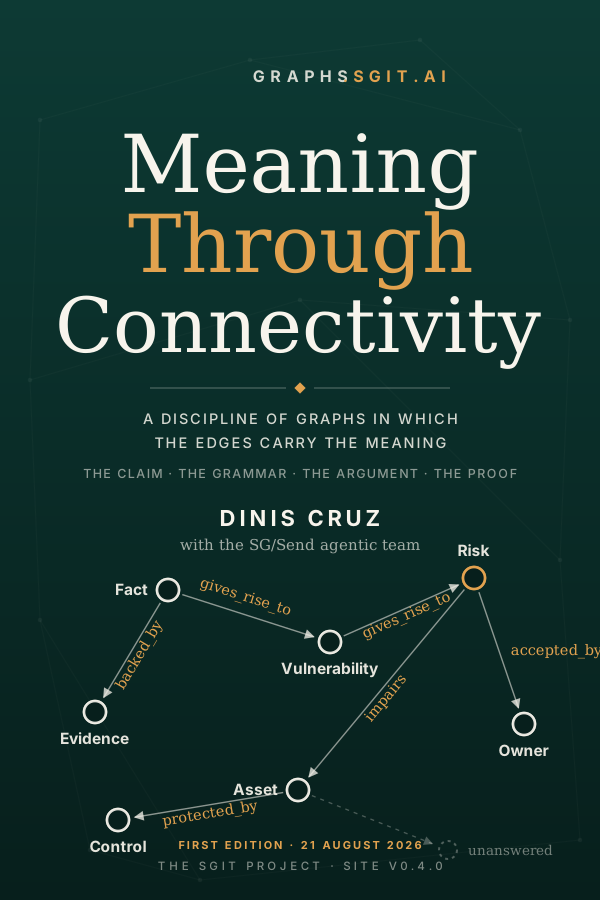
| T33 | The sources section: the fifteen documents the book was distilled from. | Founder request, 23 August 2026: a docs section in the pattern of the sibling sites, one page per source markdown file with an intro, a summary and a reader, plus a graph cross-linking each file's key concepts to where they are used on this site, so it is visible how influential each file is. Built at /docs/ with fifteen documents chosen from the 147 rows of the three source manifests (111 of which resolved against the public repositories), and extended to twenty-one at v0.3.25 on the founder's request, taking the six named as next-up in the v0.3.24 report. Carried byte-for-byte with SHA-256 and a gate check; concepts measured mechanically from a published phrase list; site links authored with a stated note. The founder asked to re-read some of them, so the reader renders the carried copy rather than a summary. | Done · v0.3.24, v0.3.25 |
| T32 | The decisions page: the register as a graph, answered in the browser. | From review r003 item 4, taken further on the founder's 23 August request: /decisions/ draws every decision as the peak of its own graph — options below it, the side effect of each option below that, the work it blocks and the pages it touches out to the sides — and lets the founder record an answer with a reason in his own browser, then copy it back as plain text. Generated from the reviews' own decisions arrays by gen_decisions.py, which fails the build if an open decision has no options authored under it. The mechanism is the Agentic Browser Isolation vault's acceptance rules, unchanged. |
Done · v0.3.22 |
| T31 | Add Issues-FS to the network chapter and the footer. | A fifth sibling site went live on 22 August (issues-fs.sgit.ai) and this book's network chapter does not know it exists. Not applied unilaterally, because the network chapter is book content and this project changes book content only by agreement: proposed here, ready to land in one release, and paired with ask N16 for the link in the other direction. | Proposed |
| T30 | Audience and translation variants, re-projected from a level. | From review r004 item 5: a business, graph-literate or non-English edition is a re-projection of an existing level from the same claims, not a rewrite of 20,000 words. One variant first, to test whether the graph really is what survives a change of audience: if the projection quietly changes the argument, that is a finding about the graph. Waits on r004 decisions D1 and D3. | Queued · on r004 D1 + D3 |
| T29 | The findings register: repeats and contradictions with states. | From review r004 item 4: the five findings the ladder produced need a permanent home with states, closed by releases, in the shape of the reviews register — otherwise a contradiction is found, forgotten and re-found. Waits on r004 decision D2. | Queued · on r004 D2 |
| T28 | Finish or adopt the altitude ladder. | From review r004 item 1: the pilot covers levels 1 to 3 fully and level 4 for two chapters. Finishing means level 4 across all seventeen units; adopting means the ladder moves into the build, authored in content/altitudes/ and gate-checked like the book, with the graph layer lifted everywhere. The cost of the next twelve chapters is now measurable rather than guessed. Waits on r004 decision D1. |
Queued · on r004 D1 |
| T27 | Reviews as folders with their own graphs, managed as issues. | From review r003 item 5: restructure to reviews/rNNN/ folders where items, decisions, evidence and thread entries are nodes with typed edges (house grammar: verbs with inverses), draw each review's graph as an SVG on its page, and manage the folder with issues logic. Waits on r003 decision D2: in-repo issues in the IssuesFS pattern (recommended) or GitHub issues. Current review URLs stay as forwards. |
Queued · on r003 D2 |
| T26 | The vault case-study programme: /vaults/, one folder and several pages per vault. |
Started 22 August, ahead of the decoupling, on the founder's instruction. Published: VoiceDebrief (overview, the junction rule, the empty layer), Regulation Graph (overview, the provenance chain, the query engines), and, on the founder's 23 August instruction to take the risk-related vaults next, Risk Mandate, Agentic Browser Isolation (overview and the acceptance mechanism) and the Risk Graph Explorer. The vaults' own published screenshots are re-published under CC BY 4.0 and their derived facts quoted rather than recounted; each page closes with what the book will cite from it. The first cross-vault finding has landed: the capability scale, which no single analysis contains. Queued next: the sgraph.ai library-as-a-vault, then the IssuesFS and EmailFS distillations. Per-vault guidance from the founder (ask N13) still shapes what comes after. | In progress · 5 of 8 |
| T25 | Decouple the book from the website: provenance replaces equality. | From review r003 item 1: the book gets its own source tree (content/book/), seeded verbatim from today's seventeen units so the split starts at zero drift; each unit carries a machine-readable provenance block (site pages, sections, site version, commit); the validate gate stops requiring the book to equal the site and starts requiring provenance to be present and resolvable, reporting rather than forbidding drift. Reader, single page, both PDFs, cover and the diff data all keep projecting from the book source unchanged. Waits on r003 decision D1. |
Queued · on r003 D1 |
| T24 | More books from the same machine. | From the N9 memo: the pipeline that produced this book (content in markdown, projected to pages, book, PDFs and cover, gate-checked) should produce others; the risk acceptance workflow is named as the next candidate, precisely because a book is a really nice way to tell an agent "read this, consume this". Requires factoring the site-specific constants out of the generators. Not started, and not before the review workflow proves itself on this book. | Queued |
| T23 | Delta editions: publish what changed, as a PDF. | From the N9 memo: on the same data as T20, generate a PDF showing only the parts of the book that changed between any two versions, so a reader of v1 can read exactly what v2.5 changed instead of re-reading the book. Not for print; for regular republication. The data layer shipped with T20; the typeset delta document is the remaining work. | Queued |
| T22 | The review loop: comment first, propose, approve, then change. | From the N9 memo. The agent's first response to a review is comments and proposed changes, never edits; a thread runs until agreement; agreed changes land and the diff view shows exactly the delta the review produced; approval, rejection and follow-up comments feed the same review or open a new one. The whole exchange is packed as JSON (the review, the text before and after, the thread, the outcome): a serverless pull request. Reviews stay linked to the version they reviewed, so when the content drifts we can ask "did later changes affect this review?" The comment stage ran for real at v0.3.8: r001.json holds nine items in proposed state with nothing changed; the discussion and per-item landing come next. | In progress · comment stage live |
| T21 | Review intake: whatever a reviewer sends becomes a presentable review page. | From the N9 memo. A review can arrive as numbered screenshots with comments, a voice memo, a document or a PDF; intake normalises it onto a web page (numbered items, each tied to the passage it is about, against the version that was reviewed) so the loop in T22 has a clean object to work on. First exercised at v0.3.8: the founder's first-reading memo became review r001, the /reviews/ section is live, and the reading screenshots join as attachments when they arrive. | In progress · r001 intaken |
| T20 | The version diff view. | Closes the foundation of N9 at v0.3.7. /book/changes.html compares any two releases of the book, GitHub-style: block-level changes with word-level detail inside modified blocks, three modes (changes only, with context, everything), per-chapter counts and a total. The data is extracted from the repository's own release tags by gen_changes.py (one frozen JSON per version, machine-readable at /book/changes/data/), and the gate fails a release whose snapshot is missing. |
Done · v0.3.7 |
| T19 | Upload day: create the store accounts and press the button. | Founder action, gated on the ISBN decision (free KDP ISBN versus Nielsen ISBNs with The SGit Project as imprint). The ordered path is the upload-day checklist: KDP paperback with a proof copy before approval, Leanpub, Zenodo (whose DOI then belongs in the colophon, a small pipeline follow-up), Google Play Books. Everything EPUB-gated stays with T13. | Open · founder |
| T18 | The publishing pages: the runbook and the metadata sheet. | Closes ask N8 at v0.3.6. /admin/publishing.html is the platform-by-platform runbook with the August 2026 numbers and the honest note on Amazon's freely-available-content policy; /admin/metadata.html is the copy-paste sheet every listing is a projection of. Both in the site nav under Site. | Done · v0.3.6 |
| T17 | The Introduction — the front page, projected into the book. | Closes ask N7 at v0.3.4. gen_book.py extracts the front page's hero and bands (minus the purely navigational ones), rewrites the site wording to book wording at the projection, and places the result before chapter 1 in the reader, single-page and both PDF editions. The gate hashes the front page's hero region the same way it hashes every chapter source: the front page is now a book source, and the two cannot drift. |
Done · v0.3.4 |
| T16 | Grow the chapter grammar: directives for the remaining components, and JS graph rendering. | Founder direction, 21 August 2026: extend the markdown grammar rather than fall back to HTML. Still embedded HTML in the markdown: the cards grid, the origins timeline, the edge-palette legend. And in-chapter graph visualisation: ```mermaid renders today; cytoscape, d3, viz.js / vis.js are the candidates for interactive graphs — which would also let the worked examples render their own node/edge data live, on the page that describes it. |
Queued |
| T15 | Move the chapter text to markdown — the editorial layer. | Done at v0.3.0: all sixteen chapters authored in content/*.md, rendered to the pages by gen_pages.py, gate-checked in both directions. Editors edit markdown and git tracks their changes cleanly; the migration was verified text-identical on every chapter before shipping. Each chapter's markdown is public at /content/<chapter>.md. |
Done · v0.3.0 |
| T14 | Ship both PDF editions from one source, versioned. | Done at v0.2.2: the screen edition (site design, US Letter, tablet-friendly) and the print interior (6″×9″) are emitted by one gen_book.py run from the same extracted chapters; each cover carries the site version, the manifest records both, and the gate refuses a release if either is missing or stale. Founder request, 21 August 2026. |
Done · v0.2.2 |
| T13 | Kindle edition — a reflowable EPUB from the same chapters. | Deliberately deferred, not forgotten: KDP does not want a PDF for ebooks — a fixed-layout conversion reads badly on every device. The right artefact is a reflowable EPUB, and the pipeline can generate one from the same extracted chapters with the same no-drift hash check. Founder decision, 21 August 2026: "let's not do kindle for now". | Queued |
| T12 | The print cover. | Done at v0.3.1, as code: gen_cover.py generates the front cover as SVG (web-reusable) and the full KDP wrap as a vector PDF — back, spine and front with bleed, the spine computed from the interior's page count and gate-checked against it, a 2″×1.2″ barcode zone at KDP's position. The cover graph is a true subgraph in the book's own edge vocabulary. Remaining at upload time only: confirm paper stock (spine assumes b/w on white, 0.002252″/page). |
Done · v0.3.1 |
| T11 | Retypeset the book PDF as a print interior in the standard technical-book format. | Done at v0.2.1: 6″×9″ trim, mirrored gutter margins, folios, running heads, recto chapter openings, a typesetter-computed contents — KDP-ready, no bleed, fonts embedded, 117 pages. The format review that produced these numbers is on the book's about page. | Done · v0.2.1 |
| T9 | Get indexed. | The measured finding behind the agent surface: an agent could fetch the parent site's index and then could not follow its links, because fetch tools refuse URLs a search has not already returned. Static HTML on GitHub Pages fixes the crawlability half; being indexed is the other half. | In progress |
Questions published unresolved
- Do the proposed inverse edge names belong in the set at all? Nine of the fifteen inverses on the edge set are this site's, not the corpus's. Publishing them makes them citable, which makes a guess durable. The alternative — publishing only the six that are sourced — leaves the vocabulary unusable. We chose usable-and-labelled; it may be the wrong call.
- Should
/start/mention that its examples come from another project? The five Reviews and the port example were written for Issues-FS, about issue tracking. The provenance is on /origins/ and in the source documents but not on the page itself, where it would cost a newcomer their first thirty seconds. - How much of the honesty framing survives contact with a first-time reader? Six pages carry a “written fresh” or “designed, not shipped” box. That is either the site's best feature or a wall of hedging, and we cannot tell from the inside.