Creating a Book Using Agentic Workflows
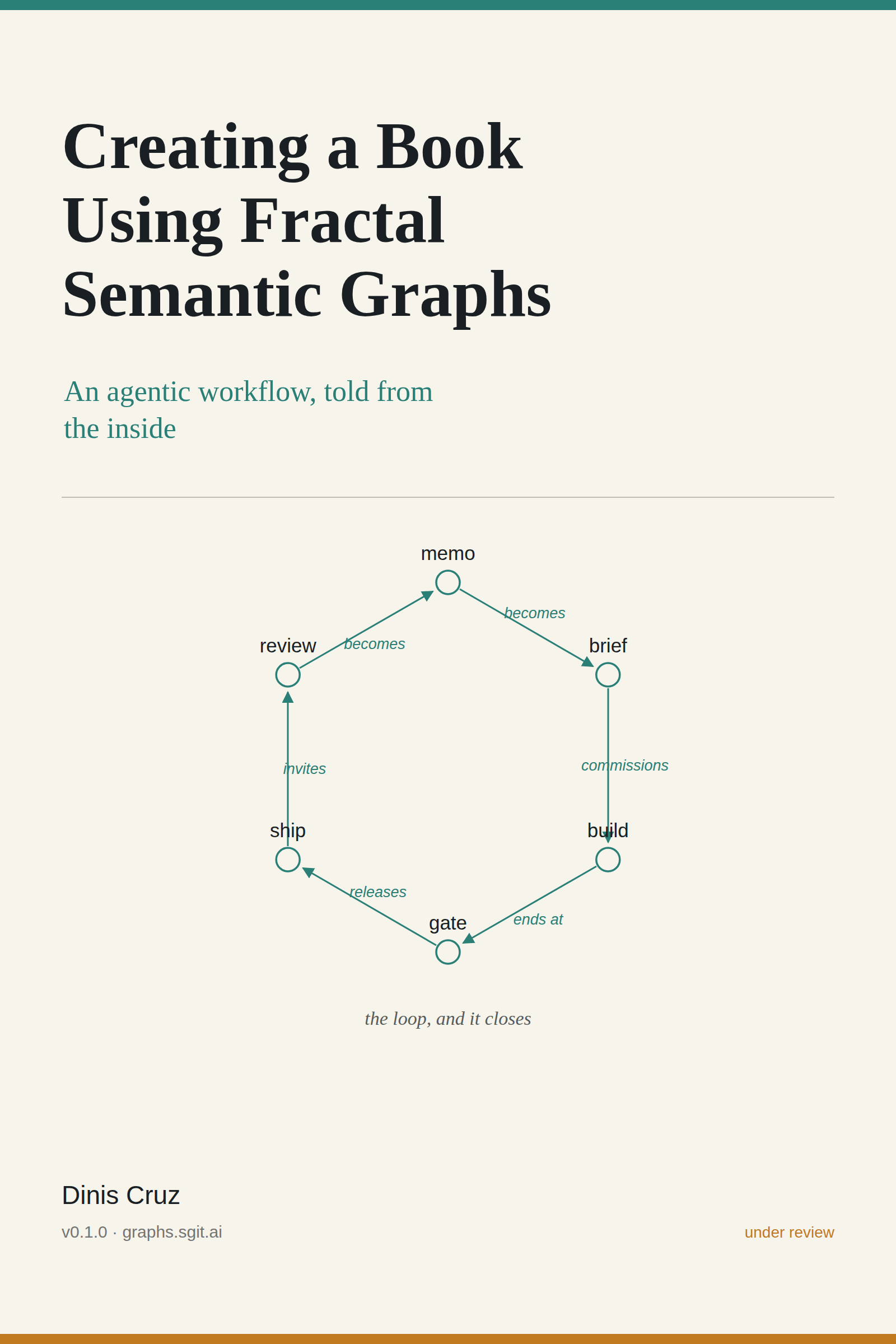
A voice memo in the morning, a shipped release by the afternoon, and a repository where every claim can be checked.
This is v0.1.0, a first release. The story runs to a point and stops honestly; the workflow it describes is still running, so later versions will carry it further. Buy it once and every future version is yours.
| Version | v0.2.0 · under review |
| Length | 17 chapters · 31,435 words · 92 pages |
| Author | Dinis Cruz |
| Licence | CC BY 4.0 — the text is free to share and adapt with attribution. |
What it is
This is the true story of how a book was written with an AI agent — the loop, the gates, the failures and the costs — told for authors who want to try the same thing.
The loop is simple enough to copy: a voice memo becomes a brief reproduced verbatim, the brief commissions a build, the build ships the same day, and a narrated review starts the next round. What makes it work is not the model but the discipline around it: gates that fail loudly, release notes written in substance rather than as a commit log, and a rule that every claim is anchored to a source or is not made.
The book is unusually checkable. It was written inside the repository it describes, so every scene can be verified at the git tag its caption names, and the screenshots of the system evolving were not re-imagined — they were re-photographed from history. The failures are told in full, including the hour lost to a zombie browser process and the bug the author caught on an iPad. It ends with a playbook that stands alone.
Who it is for
Authors, technical writers and anyone curious about what agentic work actually looks like when the record is kept honestly.
How this book is versioned
This book carries its own version, and that version moves only when the book’s content moves — the site around it releases far more often. v1.0.0 is reserved for the actual final release, so v0.2.0 says plainly that a review pass is still running. The machine-readable record is book.json, which holds the version and the SHA-256 of every chapter; a build gate fails if content changes without the version moving.